

Parallel Verses
Daniel Mace New Testament
I know thy works, that thou art neither cold nor hot: I would thou wert cold or hot.
New American Standard Bible
King James Version
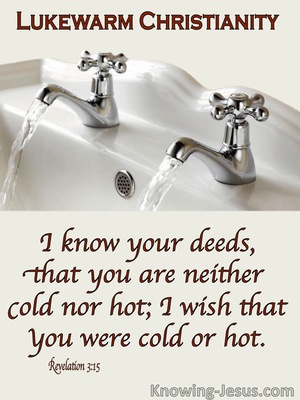
I know thy works, that thou art neither cold nor hot: I would thou wert cold or hot.
Holman Bible
International Standard Version
"I know your actions, that you are neither cold nor hot. I wish you were cold or hot.
A Conservative Version
I know thy works, that thou are neither cold nor hot. O that thou were cold or hot.
American Standard Version
I know thy works, that thou art neither cold nor hot: I would thou wert cold or hot.
Amplified
An Understandable Version
I know about your deeds, that you are neither [spiritually] cold nor hot. I wish you were [either] cold or hot.
Anderson New Testament
I know your works, that you are neither cold, nor hot: I wish that you were cold, or hot.
Bible in Basic English
I have knowledge of your works, that you are not cold or warm: it would be better if you were cold or warm.
Common New Testament
I know your works, that you are neither cold nor hot. I could wish you were cold or hot!
Darby Translation
I know thy works, that thou art neither cold nor hot; I would thou wert cold or hot.
Emphatic Diaglott Bible
I know your works, that you are neither cold nor hot: I wish you were either cold or hot.
Godbey New Testament
I know your works, that you are neither cold nor hot. I would that you were either cold or hot.
Goodspeed New Testament
I know what you are doing, and that you are neither cold nor hot. I wish you were either cold or hot!
John Wesley New Testament
I know thy works, that thou art neither cold nor hot: O that thou wert cold or hot!
Julia Smith Translation
I know thy works, that thou art neither cold nor boiling: I would thou shouldest be cold or boiling.
King James 2000
I know your works, that you are neither cold nor hot: I would that you were cold or hot.
Lexham Expanded Bible
'I know your works, that you are neither cold nor hot. Would that you were cold or hot!
Modern King James verseion
I know your works, that you are neither cold nor hot. I would that you were cold or hot.
Modern Spelling Tyndale-Coverdale
I know thy works, that thou art neither cold nor hot. I would thou were cold or hot.
Moffatt New Testament
I know your doings, you are neither cold nor hot ??would you were either cold or hot!
Montgomery New Testament
I know your works, that you are neither hot nor cold.
NET Bible
I know your deeds, that you are neither cold nor hot. I wish you were either cold or hot!
New Heart English Bible
"I know your works, that you are neither cold nor hot. I wish you were cold or hot.
Noyes New Testament
I know thy works, that thou art neither cold nor hot; I would thou wert cold or hot.
Sawyer New Testament
I know your works, that you are neither cold nor hot. I wish you were cold or hot.
The Emphasized Bible
I know thy works; - that neither, cold, art thou, nor hot: I would that, cold, thou hadst been, or hot.
Thomas Haweis New Testament
I know thy works, that thou art neither cold nor hot:
Twentieth Century New Testament
I know your life; I know that you are neither cold nor hot. Would that you were either cold or hot!
Webster
I know thy works, that thou art neither cold nor hot: I would thou wert cold or hot.
Weymouth New Testament
I know your doings--you are neither cold nor hot; I would that you were cold or hot!
Williams New Testament
"I know what you are doing, and that you are neither cold nor hot. I wish you were cold or hot.
World English Bible
"I know your works, that you are neither cold nor hot. I wish you were cold or hot.
Worrell New Testament
"I know your works, that you are neither cold nor hot. I would you were cold or hot.
Worsley New Testament
I wish thou wert cold or hot.
Youngs Literal Translation
I have known thy works, that neither cold art thou nor hot; I would thou wert cold or hot.
Themes
Backsliders » Instances of » Churches of asia
Chastisement » Who the lord chastens
Coming » Who God the father and jesus Christ come to
Government » Who shall reign with the lord
Hearing » Those that hear the lord
Indifference » The reward for being lukewarm
Laodicea » Message to, through john
Love » Those whom the lord loves
Lukewarmness » Instances of » A congregation at » Laodicea
References
Word Count of 38 Translations in Revelation 3:15
Images Revelation 3:15


Prayers for Revelation 3:15
Verse Info
Context Readings
The Letter To The Church In Laodicea
14 And unto the angel of the church of the Laodiceans, write, "these things saith the AMEN, the faithful and true witness, the beginning of the creation of God; 15 I know thy works, that thou art neither cold nor hot: I would thou wert cold or hot. 16 but since thou art lukewarm, and neither cold nor hot, I will spue thee out of my mouth.
Phrases
Cross References
Matthew 24:12
and as iniquity becomes more flagrant, the zeal of many will grow cool.
Romans 12:11
in business be not slothful, but of an active mind, making the best use of every incident.
Revelation 3:1
And unto the angel of the church in Sardis, write, "THESE things saith he that hath the seven spirits of God and the seven stars; I know thy works, that thou hast the reputation of being alive, but art dead.
Matthew 6:24
no man can serve two masters: for either he will hate the one, and love the other; or he will be attach'd to the one, and neglectful of the other. ye cannot serve God and Mamon.
Matthew 10:37
he that loveth father or mother more than me, is unworthy of me: he that loveth son or daughter more than me, is unworthy of me.
Luke 14:27-28
and he that does not bear his cross, and tread in my steps, cannot be my disciple.
1 Corinthians 16:22
If any man love not the Lord Jesus Christ, let him be accurst.
2 Corinthians 12:20
yet I fear when I do come I shall not find you such as I would, and that you will find me such as you least desire: I am afraid there are among you debates, envyings, animosities, strifes, backbitings, whisperings, arrogance, tumults:
Philippians 1:9
and the favour I ask of him is this, that your kindness to me may be crown'd with farther improvements in knowledge and all prudence;
2 Thessalonians 1:3
We are oblig'd, my brethren, to render thanks to God continually upon your account, as it is but just; since your faith still improves, and your mutual love is always increasing.
James 1:8
a diffident man is inconstant in all his actions.
1 Peter 1:22
You that have purified your souls by the holy spirit, in obeying the gospel, which obliges you to an undisguised benevolence, let your hearts be mutually affected with the most disinterested ardour;
Revelation 2:2
I know thy works, thy labour, and thy patience, and that thou canst not bear those who are evil: thou hast tried those who say they are apostles, but are not; and hast found them lyars:
Revelation 2:4
nevertheless, I have somewhat against thee, because thou hast left thy first love.