




Parallel Verses
Weymouth New Testament
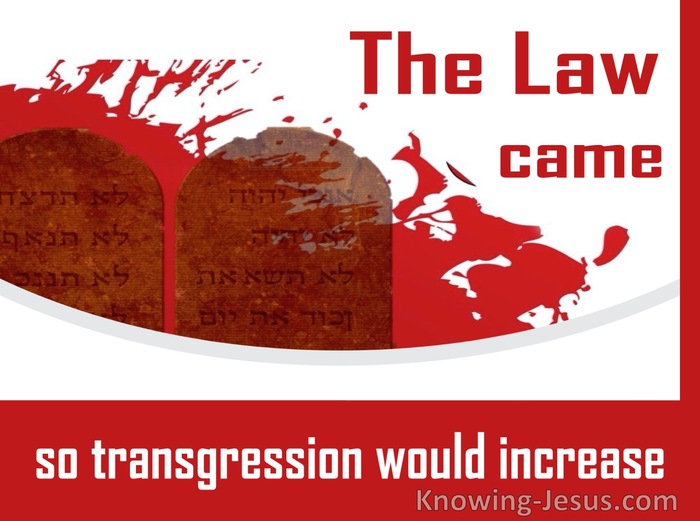
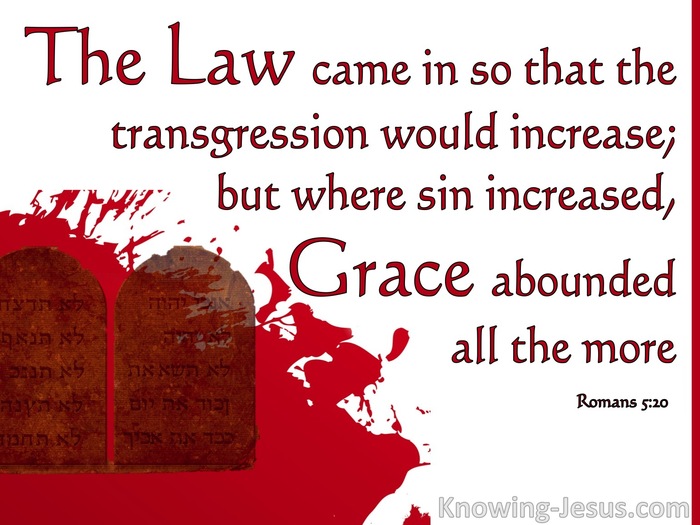
Now Law was brought in later on, so that transgression might increase. But where sin increased, grace has overflowed;
New American Standard Bible
King James Version
Moreover the law entered, that the offence might abound. But where sin abounded, grace did much more abound:
Holman Bible
The law came along to multiply the trespass.
International Standard Version
Now the Law crept in so that the offense would increase. But where sin increased, grace increased even more,
A Conservative Version
And the law entered so that the offence might abound. But where sin abounded, grace was more abundant,
American Standard Version
And the law came in besides, that the trespass might abound; but where sin abounded, grace did abound more exceedingly:
Amplified
But the Law came to increase and expand [the awareness of] the trespass [by defining and unmasking sin]. But where sin increased, [God’s remarkable, gracious gift of] grace [His unmerited favor] has surpassed it and increased all the more,
An Understandable Version
Now the law of Moses was introduced [into the world] in order to cause sin to increase [i.e., it defined many things to be wrong that were previously not regarded as sin]. But with the increase of sin, God's unearned favor increased all the more.
Anderson New Testament
But, besides the first offense, law was introduced, in order that offenses might abound: but where sin abounded, grace did much more abound:
Bible in Basic English
And the law came in addition, to make wrongdoing worse; but where there was much sin, there was much more grace:
Common New Testament
Law came in, that the trespass might increase. But where sin increased, grace abounded all the more,
Daniel Mace New Testament
the law was introduc'd, that the greatness of the fall might fully appear; but the more sin display'd its enormity, the divine favour was so much the more transcendent.
Darby Translation
But law came in, in order that the offence might abound; but where sin abounded grace has overabounded,
Godbey New Testament
But the law came, that the transgression might abound; but where sin did abound, there did grace superabound:
Goodspeed New Testament
Then law slipped in, and multiplied the offense. But greatly as sin multiplied, God's mercy has far surpassed it,
John Wesley New Testament
But the law came in between, that the offence might abound: yet where sin abounded, grace did much more abound:
Julia Smith Translation
And the law entered, that the fall might abound. And where sin abounded, grace superabounded:
King James 2000
Moreover the law entered, that the offense might abound. But where sin abounded, grace did much more abound:
Lexham Expanded Bible
Now the law came in as a side issue, in order that the trespass could increase, but where sin increased, grace was present in greater abundance,
Modern King James verseion
But the Law entered so that the offense might abound. But where sin abounded, grace did much more abound,
Modern Spelling Tyndale-Coverdale
But the law, in the meantime, entered in that sin should increase. Neverthelater, where abundance of sin was, there was more plenteousness of grace.
Moffatt New Testament
Law slipped in to aggravate the trespass; sin increased, but grace surpassed it far,
Montgomery New Testament
Now law was brought in so that transgression might abound; but where sin abounded, grace super-abounded;
NET Bible
Now the law came in so that the transgression may increase, but where sin increased, grace multiplied all the more,
New Heart English Bible
The law came in besides, that the trespass might abound; but where sin abounded, grace abounded more exceedingly;
Noyes New Testament
Moreover the law came in in addition, that the trespass might abound; but where sin abounded, grace abounded much more;
Sawyer New Testament
For the law supervened that the fall might abound; but where the sin abounded the grace was superabundant,
The Emphasized Bible
Law, however, gained admission, in order that the fault might abound, but, where the sin abounded, the favour greatly superabounded:
Thomas Haweis New Testament
But the law was introduced, that the offence might be more abundant. But where sin had abounded, there hath grace abounded more exceedingly:
Twentieth Century New Testament
Law was introduced in order that offences might be multiplied. But, where sins were multiplied, the loving-kindness of God was lavished the more,
Webster
Moreover the law entered, that the offense might abound. But where sin abounded, grace did much more abound:
Williams New Testament
Then law crept in to multiply the offense. Though sin has multiplied, yet God's favor has surpassed it and overflowed,
World English Bible
The law came in besides, that the trespass might abound; but where sin abounded, grace abounded more exceedingly;
Worrell New Testament
And the law entered, that the trespass might abound; but where sin abounded, grace did super-abound;
Worsley New Testament
Now the law made some entrance, that the offence might appear to abound; but where sin abounded, grace hath superabounded; that as sin had reigned in death,
Youngs Literal Translation
And law came in, that the offence might abound, and where the sin did abound, the grace did overabound,
Themes
Adam » The first man. Creation of » Temptation and sin of
death » How death entered into the world
Grace » Described as » All-abundant
Justification before God » Under the gospel » Is of grace
Topics
Interlinear
De
De
References
Word Count of 37 Translations in Romans 5:20
Images Romans 5:20





Prayers for Romans 5:20
Verse Info
Context Readings
Death Came Through Adam But Life Comes Through Christ
19 For as through the disobedience of the one individual the mass of mankind were constituted sinners, so also through the obedience of the One the mass of mankind will be constituted righteous. 20 Now Law was brought in later on, so that transgression might increase. But where sin increased, grace has overflowed; 21 in order that as sin has exercised kingly sway in inflicting death, so grace, too, may exercise kingly sway in bestowing a righteousness which results in the Life of the Ages through Jesus Christ our Lord.
Cross References
Romans 6:1
To what conclusion, then, shall we come? Are we to persist in sinning in order that the grace extended to us may be the greater?
Matthew 9:13
But go and learn what this means, 'It is mercy that I desire, not sacrifice'; for I did not come to appeal to the righteous, but to sinners."
Luke 7:47
This is the reason why I tell you that her sins, her many sins, are forgiven--because she has loved much; but he who is forgiven little, loves little."
Luke 23:39-43
Now one of the criminals who had been crucified insulted Him, saying, "Are not you the Christ? Save yourself and us."
John 10:10
The thief comes only to steal and kill and destroy: I have come that they may have Life, and may have it in abundance.
John 15:22
"If I had not come and spoken to them, they would have had no sin; but as the case stands they are without excuse for their sin.
Romans 3:19-20
But it cannot be denied that all that the Law says is addressed to those who are living under the Law, in order that every mouth may be stopped, and that the whole world may await sentence from God.
Romans 4:15
For the Law inflicts punishment; but where no Law exists, there can be no violation of Law.
Romans 6:14
For Sin shall not be lord over you, since you are subjects not of Law, but of grace.
Romans 7:5-13
For whilst we were under the thraldom of our earthly natures, sinful passions-- made sinful by the Law--were always being aroused to action in our bodily faculties that they might yield fruit to death.
1 Corinthians 6:9-11
Do you not know that unrighteous men will not inherit God's Kingdom? Cherish no delusion here. Neither fornicators, nor idolaters, nor adulterers, nor any who are guilty of unnatural crime,
2 Corinthians 3:7-9
If, however, the service that proclaims death--its code being engraved in writing upon stones--came with glory, so that the children of Israel could not look steadily on the face of Moses because of the brightness of his face--a vanishing brightness;
Galatians 3:19-25
Why then was the Law given? It was imposed later on for the sake of defining sin, until the seed should come to whom God had made the promise; and its details were laid down by a mediator with the help of angels.
Ephesians 1:6-8
to the praise of the splendour of His grace with which He has enriched us in the beloved One.
Ephesians 2:1-5
To you Gentiles also, who were dead through your offences and sins,
1 Timothy 1:13-16
though I was previously a blasphemer and a persecutor and had been insolent in outrage. Yet mercy was shown me, because I had acted ignorantly, not having as yet believed;
Titus 3:3-7
For there was a time when we also were deficient in understanding, obstinate, deluded, the slaves of various cravings and pleasures, spending our lives in malice and envy, hateful ourselves and hating one another.