
Parallel Verses
Twentieth Century New Testament
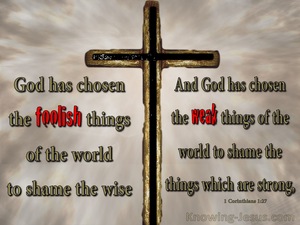
But God chose what the world counts foolish to put its wise men to shame, and God chose what the world counts weak to put its strong things to shame,
New American Standard Bible
but
King James Version
But God hath chosen the foolish things of the world to confound the wise; and God hath chosen the weak things of the world to confound the things which are mighty;
Holman Bible
Instead, God has chosen
International Standard Version
But God chose what is nonsense in the world to make the wise feel ashamed. God chose what is weak in the world to make the strong feel ashamed.
A Conservative Version
But God chose the foolish things of the world, so that he might humiliate the wise, and God chose the weak things of the world, so that he might humiliate the powerful.
American Standard Version
but God chose the foolish things of the world, that he might put to shame them that are wise; and God chose the weak things of the world, that he might put to shame the things that are strong;
Amplified
But God has selected [for His purpose] the foolish things of the world to shame the wise [revealing their ignorance], and God has selected [for His purpose] the weak things of the world to shame the things which are strong [revealing their frailty].
An Understandable Version
But God chose what the world considers foolish [i.e., people with little apparent ability], in order to shame the "wise people." And He chose what the world considers weak in order to shame what it considers strong.
Anderson New Testament
but God has chosen the foolish things of the world, that he may bring to shame the wise; and the weak things of the world has God chosen, that he may put to shame the strong;
Bible in Basic English
But God made selection of the foolish things of this world so that he might put the wise to shame; and the feeble things that he might put to shame the strong;
Common New Testament
But God chose the foolish things of the world to shame the wise, God chose the weak things of the world to shame the strong,
Daniel Mace New Testament
but God hath chosen those who are foolish in the opinion of the world, to confound the wise; and the weak men of the world to confound the mighty:
Darby Translation
But God has chosen the foolish things of the world, that he may put to shame the wise; and God has chosen the weak things of the world, that he may put to shame the strong things;
Godbey New Testament
but God has chosen the foolish things of the world, that he may confound the wise; and God has chosen the weak things of the world, that he may confound the strong;
Goodspeed New Testament
But it was what the world calls foolish that God chose to put the wise to shame with, and it was what the world calls weak that God chose to shame its strength with,
John Wesley New Testament
But God hath chosen the foolish things of the world, to shame the wise, and the weak things of the world, to shame the things that are mighty:
Julia Smith Translation
But the foolish things of the world, has God chosen that he might shame the wise; and the weak things of the world has God chosen that he might shame things strong;
King James 2000
But God has chosen the foolish things of the world to confound the wise; and God has chosen the weak things of the world to confound the things which are mighty;
Lexham Expanded Bible
But the foolish [things] of the world God chose in order that he might put to shame the wise, and the weak [things] of the world God chose in order that he might put to shame the strong,
Modern King James verseion
But God has chosen the foolish things of the world to confound the wise; and God has chosen the weak things of the world to confound the things which are mighty;
Modern Spelling Tyndale-Coverdale
But God hath chosen the foolish things of the world, to confound the wise. And God hath chosen the weak things of the world, to confound things which are mighty.
Moffatt New Testament
No, God has chosen what is foolish in the world to shame the wise; God has chosen what is weak in the world to shame what is strong;
Montgomery New Testament
No, God has chosen the world's folly to confound its philosophy; and the world's weakness to confound its strength.
NET Bible
But God chose what the world thinks foolish to shame the wise, and God chose what the world thinks weak to shame the strong.
New Heart English Bible
But God chose the foolish of the world to shame the wise. And God chose the weak of the world to shame the strong.
Noyes New Testament
but the foolish things of the world did God choose, to put to shame the wise; and the weak things of the world did God choose, to put to shame the things which are strong;
Sawyer New Testament
but God has chosen the foolish things of the world to confound the wise, and the weak things of the world has God chosen to put to shame the mighty,
The Emphasized Bible
On the contrary - the foolish things of the world, hath God chosen, that he might put to shame them who are wise, and, the weak things of the world, hath God chosen, that he might put to shame the things that are mighty,
Thomas Haweis New Testament
but the foolish things of this world hath God elected, that he might confound the wise; and the feeble things of the world hath God elected, that he might confound the mighty;
Webster
But God hath chosen the foolish things of the world to confound the wise; and God hath chosen the weak things of the world to confound the things which are mighty;
Weymouth New Testament
But God has chosen the things which the world regards as foolish, in order to put its wise men to shame; and God has chosen the things which the world regards as destitute of influence, in order to put its powerful things to shame;
Williams New Testament
Just the opposite: God chose what the world calls foolish to put the wise to shame, what the world calls weak to put the strong to shame,
World English Bible
but God chose the foolish things of the world that he might put to shame those who are wise. God chose the weak things of the world, that he might put to shame the things that are strong;
Worrell New Testament
but God chose the foolish things of the world, that He might put to shame the wise; and God chose the weak things of the world, that He might put to shame the things that are strong;
Worsley New Testament
but God hath chosen things that are foolish in the eye of the world to put it's wise men to confusion; and God hath chosen the weak things of the world to confound the mighty;
Youngs Literal Translation
but the foolish things of the world did God choose, that the wise He may put to shame; and the weak things of the world did God choose that He may put to shame the strong;
Themes
Chosen Instruments » Men of God
Chosen Instruments » Men of God, chosen instruments to accomplish God's purposes
Election » Of saints, is » Sovereign
Jesus Christ » Who is in jesus Christ
Missionaries » Encouragement to
Missionaries » However weak they may be
Power » Small things God uses » God's instrument case
Reasoning » The gospel cannot be explained by
Topics
Interlinear
theos
θεός
theos
Usage: 1151
Eklegomai
ἐκλέγομαι
Eklegomai
Usage: 14
Kataischuno
καταισχύνω
Kataischuno
Usage: 13
Asthenes
References
Word Count of 37 Translations in 1 Corinthians 1:27
Images 1 Corinthians 1:27

Prayers for 1 Corinthians 1:27
Verse Info
Context Readings
Boast In The Lord
26 Look at the facts of your Call, Brothers. There are not many among you who are wise, as men reckon wisdom, not many who are influential, not many who are high-born; 27 But God chose what the world counts foolish to put its wise men to shame, and God chose what the world counts weak to put its strong things to shame, 28 And God chose what the world counts poor and insignificant-- things that to it are unreal-to bring its 'realities' to nothing,
Names
Cross References
1 Corinthians 1:20
Where is the Philosopher? where the Teacher of the Law? where the Disputant of to-day? Has not God shown the world's philosophy to be folly?
James 2:5
Listen, my dear Brothers. Has not God chosen those who are poor in the things of this world to be rich through their faith, and to possess the Kingdom which he has promised to those who love him?
Matthew 4:18-22
As Jesus was walking along the shore of the Sea of Galilee, he saw two brothers--Simon, also known as Peter, and his brother Andrew--casting a net into the Sea; for they were fishermen.
Matthew 9:9
As Jesus went along, he saw a man, called Matthew, sitting in the tax-office, and said to him: "Follow me." Matthew got up and followed him.
Matthew 11:25
At that same time Jesus uttered the words: "I thank thee, Father, Lord of Heaven and earth, that, though thou has hidden these things from the wise and learned, thou hast revealed them to the child-like!
Matthew 21:16
And said to him: "Do you hear what these boys are saying?" "Yes," answered Jesus; "but did you never read the words--'Out of the mouths of babes and sucklings thou hast called forth perfect praise'?"
Luke 19:39-40
Some of the Pharisees in the crowd said to him: "Teacher, reprove your disciples."
Luke 21:15
For I will myself give you words, and a wisdom which all your opponents together will be unable to resist or defy.
Acts 4:11-21
Jesus is 'the stone which, scorned by you the builders, has yet become the corner stone.'
Acts 6:9-10
But some members of the Synagogue known as that of Libertines, Cyrenians, Alexandrians, and Visitors from Cilicia and Roman Asia, were roused to action and began disputing with Stephen;
Acts 7:35
This same Moses, whom they had disowned with the words--'Who made you a ruler and a judge?' was the very man whom God sent to be both a ruler and a deliverer, under the guidance of the angel that had appeared to him in the bush.
Acts 7:54
As they listened to this, the Council grew frantic with rage, and gnashed their teeth at Stephen.
Acts 17:18
Among others, some Epicurean and Stoic Philosophers joined issue with him. Some would ask "What is this prater wanting to make out?", while others would say "He seems to be a Preacher of foreign Deities." (This was because he was telling the Good News about Jesus and the Resurrection).
Acts 24:24-25
Some days later Felix came with his wife Drusilla, who was herself a Jewess, and, sending for Paul, listened to what he had to say about faith in Christ Jesus.
2 Corinthians 4:7
This treasure we have in these earthen vessels, that its all- prevailing power may be seen to come from God, and not to be our own.
2 Corinthians 10:4-5
The weapons for our warfare are not earthly, but, under God, are powerful enough to pull down strongholds.
2 Corinthians 10:10
For people say "His letters are impressive and vigorous, but his personal appearance is insignificant and his speaking contemptible."