
Parallel Verses
An Understandable Version
Even King David also spoke of the blessing experienced by the person who was considered righteous by God apart from doing good deeds.
New American Standard Bible
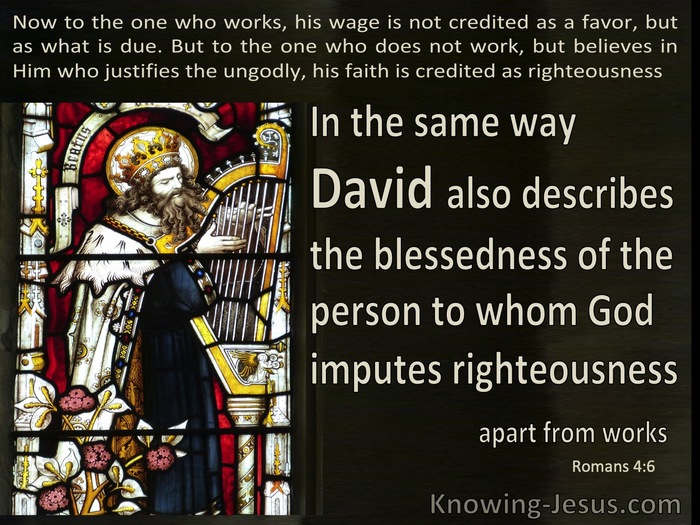
just as David also speaks of the blessing on the man to whom God credits righteousness apart from works:
King James Version
Even as David also describeth the blessedness of the man, unto whom God imputeth righteousness without works,
Holman Bible
Likewise, David also speaks of the blessing of the man God credits righteousness to apart from works:
International Standard Version
Likewise, David also speaks of the blessedness of the person whom God regards as righteous apart from actions:
A Conservative Version
Just as David also tells the blessedness of the man to whom God imputes righteousness independent of works,
American Standard Version
Even as David also pronounceth blessing upon the man, unto whom God reckoneth righteousness apart from works,
Amplified
And in this same way David speaks of the blessing on the one to whom God credits righteousness apart from works:
Anderson New Testament
Even as David also speaks of the blessedness of the man to whom God counts righteousness without works, saying:
Bible in Basic English
As David says that there is a blessing on the man to whose account God puts righteousness without works, saying,
Common New Testament
So also David describes the blessedness of the man to whom God reckons righteousness apart from works:
Daniel Mace New Testament
even as David also speaks of the happiness of the man whom God accounted righteous independently of his works,
Darby Translation
Even as David also declares the blessedness of the man to whom God reckons righteousness without works:
Godbey New Testament
Indeed David also speaks of the blessedness of the man, to whom God imputes righteousness without works,
Goodspeed New Testament
So David himself says of the happiness of those to whom God credits uprightness without any reference to their actions,
John Wesley New Testament
So David also describeth the happiness of the man, to whom God imputeth righteousness without works:
Julia Smith Translation
As also David speaks the happiness of the man, to whom God reckons justice without works,
King James 2000
Even as David also describes the blessedness of the man, unto whom God imputes righteousness without works,
Lexham Expanded Bible
just as David also speaks about the blessing of the person to whom God credits righteousness apart from works:
Modern King James verseion
Even as David also says of the blessedness of the man to whom God imputes righteousness without works,
Modern Spelling Tyndale-Coverdale
Even as David describeth the blessedfulness of the man, unto whom God ascribeth righteousness without deeds,
Moffatt New Testament
Just as David himself describes the bliss of the man who has righteousness counted to him by God apart from what he does ??7 Blessed are they whose breaches of the Law are forgiven, whose sins are covered!
Montgomery New Testament
Just as David also speaks of the blessedness of the man to whom God imputes righteousness apart from actions.
NET Bible
So even David himself speaks regarding the blessedness of the man to whom God credits righteousness apart from works:
New Heart English Bible
Even as David also pronounces blessing on the man to whom God counts righteousness apart from works,
Noyes New Testament
as David also speaketh of the blessedness of the man whom God accepteth as righteous without works:
Sawyer New Testament
As David describes the blessedness of the man to whom the Lord accounts righteousness without works,
The Emphasized Bible
Just as David also affirmeth the happiness of the man unto whom God reckoneth righteousness apart from works: -
Thomas Haweis New Testament
As David also describeth the blessedness of that man, to whom God imputeth righteousness without works,
Twentieth Century New Testament
In precisely the same way David speaks of the blessing pronounced upon the man who is regarded by God as righteous apart from actions--
Webster
Even as David also describeth the blessedness of the man to whom God imputeth righteousness without works,
Weymouth New Testament
In this way David also tells of the blessedness of the man to whose credit God places righteousness, apart from his actions.
Williams New Testament
So David, too, describes the happiness of the man to whom God credits right standing with Himself, without the things he does having anything to do with it:
World English Bible
Even as David also pronounces blessing on the man to whom God counts righteousness apart from works,
Worrell New Testament
Even as David also speaks of the blessedness of the man to whom God reckoneth righteousness, apart from works,
Worsley New Testament
As David also describeth the blessedness of the man to whom: God imputeth righteousness without works, saying,
Youngs Literal Translation
even as David also doth speak of the happiness of the man to whom God doth reckon righteousness apart from works:
Themes
Bigotry » Paul's argument against
the Blessed » To whom God imputes righteousness without works
Forgiveness » Those whose iniquities are forgiven
Righteousness » Blessedness of » Having imputed, without works
Interlinear
Hos
Logizomai
References
Word Count of 37 Translations in Romans 4:6
Images Romans 4:6

Prayers for Romans 4:6
Verse Info
Context Readings
Abraham's Faith Counted As Righteousness
5 But to the person who believes in God, who makes ungodly people right with Himself apart from doing good deeds, that person's faith is considered by God [as the basis] for being righteous. 6 Even King David also spoke of the blessing experienced by the person who was considered righteous by God apart from doing good deeds. 7 He said [Psa. 32:1ff], "Those people whose ungodly deeds are forgiven [by God] and whose sins are covered over, are [truly] blessed.
Names
Cross References
Matthew 5:3-12
"Those persons who feel a deep sense of their personal need are blessed because the kingdom of heaven belongs to them.
Romans 1:17
For the Gospel reveals how a person can be made right with God. It is through faith [in Jesus], from beginning to end, just as it is written [Hab. 2:4], "The righteous person will [obtain] life by [his] faith [in God]."
Romans 3:20-22
This is because no human being can be considered right with God by [obeying] the requirements of a law. [Note: It is difficult to determine the exact sense in which "law" is used in these verses. It may be law generally, or the law of Moses specifically. See Bruce, pages 52-58]. For the knowledge of what sin is comes from the law of Moses.
Romans 3:27
Where then is the [basis for] boasting [i.e., over being right with God]? There is not any. Is it by [obedience to] a law? Is it by doing certain deeds? Not at all, but by a law of faith.
Romans 4:9
Is this blessing experienced by the circumcised ones [i.e., the Jews only] or by the uncircumcised ones [i.e., the Gentiles] also? We are saying, "Abraham's faith was credited to him for righteousness."
Romans 4:11
He received the sign of circumcision as a seal [confirming] that he had been [considered] righteous because of the faith he had before being circumcised. Thus, he became the [spiritual] father of all people who believe [in God], even though they have not been circumcised, so that they could be considered righteous [by their faith].
Romans 4:24
but they were written for our sake also, who will be considered righteous by God for believing in Him who raised Jesus our Lord from the dead.
Romans 5:18-19
So then, just as [God's] judgment came, condemning all people [to physical death] because of one sin [i.e., Adam's]; even so the free gift of being made right with God and [resulting in] life may be received by all people because of one man's [i.e., Christ's] act of righteousness. [Note: This "life" may refer to spiritual life now, or to being made alive in the resurrection, which would reverse the curse of physical death caused by Adam's sin].
1 Corinthians 1:30
But God brought you into [fellowship with] Christ Jesus, who was made to be God's wisdom for us. Through Christ you have received a right relationship with God, [as well as] holiness and redemption [i.e., being bought back from Satan].
2 Corinthians 5:21
God considered Christ to be sinful on our behalf, even though He never sinned, so that we could be considered right with God through Him.
Galatians 3:8-9
And, predicting that God would consider the Gentiles right with Him by [their] faith, the Scriptures previously recorded [this promise of] the Gospel to Abraham by saying [Gen. 12:3], "All nations will receive a blessing through your descendant [i.e., Jesus]."
Galatians 3:14
[This happened] so that the blessing [promised] to Abraham might be received by the Gentiles through [the person and work of] Christ, so that we might receive the promised [gift of the] Holy Spirit through [our] faith [in Jesus].
Galatians 4:15
Now where are those good feelings you had for me? For I can [honestly] testify that [at one time] you would have even gouged out your eyes and given them to me [for sight] if that had been possible.
Ephesians 1:3
May the God and Father of our Lord Jesus Christ be praised, for He has blessed us with every spiritual blessing in the heavenly realms in [fellowship with] Christ. [Note: The term "heavenly realms" is used somewhat differently throughout this book. Here it refers to Christians as part of the church on earth].
Ephesians 2:8-10
For you have been saved by God's unearned favor, through [your] faith, and that [salvation] was not the result of your own doing; it was the gift from God.
Philippians 3:9
and to be found in [fellowship with] Him, not having a righteousness of my own, acquired by observing the law of Moses, but one acquired through believing in Christ. This righteousness, which comes from God, is based on faith.
2 Timothy 1:9
[It is] God who saved us and called us to live holy lives [or, "to be dedicated people"], not as a result of our [good] deeds, but in harmony with His own purpose and unearned favor. [This was] given to us through [the atoning work of] Christ Jesus, before the beginning of time. [Note: Salvation through Christ was planned before time began. See Titus 1:2; Rom. 16:25; Eph. 1:4].
2 Peter 1:1
[This letter is being written by] Simon Peter, a slave and apostle of Jesus Christ, to those who have received a faith just as precious as ours, through the righteousness of our God and Savior Jesus Christ.