
Parallel Verses
Common New Testament
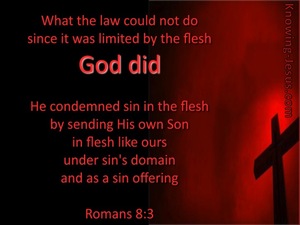
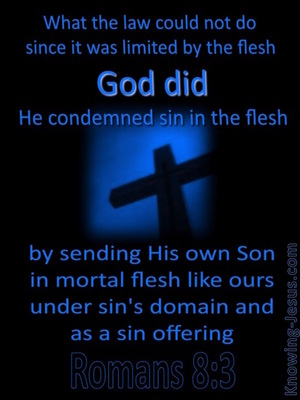
For what the law could not do, in that it was weakened through the flesh, God did by sending his own Son in the likeness of sinful flesh, and for sin: he condemned sin in the flesh,
New American Standard Bible
For
King James Version
For what the law could not do, in that it was weak through the flesh, God sending his own Son in the likeness of sinful flesh, and for sin, condemned sin in the flesh:
Holman Bible
What the law could not do
International Standard Version
For what the Law was powerless to do in that it was weakened by the flesh, God did. By sending his own Son in the form of humanity, he condemned sin by being incarnate,
A Conservative Version
For the impotence of the law, in that it was weak because of the flesh, God, having sent his own Son in a form of flesh of sin, and concerning sin, condemned sin in the flesh,
American Standard Version
For what the law could not do, in that it was weak through the flesh, God, sending his own Son in the likeness of sinful flesh and for sin, condemned sin in the flesh:
Amplified
For what the Law could not do [that is, overcome sin and remove its penalty, its power] being weakened by the flesh [man’s nature without the Holy Spirit], God did: He sent His own Son in the likeness of sinful man as an offering for sin. And He condemned sin in the flesh [subdued it and overcame it in the person of His own Son],
An Understandable Version
For what the law was not able to do [for mankind], since it was [too] weak [to deliver them from condemnation] because fleshly people [were unable to obey it perfectly], God condemned sin in the flesh [i.e., sin was declared evil and its power over man broken]. God did this by sending His own Son in a body like sinful man's, and to destroy sin,
Anderson New Testament
For what the law could not do, because it was weak through the flesh, God has done, who, sending his own son in the likeness of sinful flesh, and for a sin-offering, condemned sin in the flesh,
Bible in Basic English
For what the law was not able to do because it was feeble through the flesh, God, sending his Son in the image of the evil flesh, and as an offering for sin, gave his decision against sin in the flesh:
Daniel Mace New Testament
God having sent his own son invested with a body like that of sinful men, as a sacrifice for sin, thereby destroyed its power; which the law could not effect, human nature being in such a corrupted state.
Darby Translation
For what the law could not do, in that it was weak through the flesh, God, having sent his own Son, in likeness of flesh of sin, and for sin, has condemned sin in the flesh,
Godbey New Testament
For there was an impotency of the law, in which it was weak through depravity, God having sent his own Son in the likeness of the sin of depravity and for sin, condemned sin in depravity:
Goodspeed New Testament
For though it was impossible for the Law to do it, hampered as it was by our physical limitations, God, by sending his own Son in our sinful physical form, as a sin-offering, put his condemnation upon sin through his physical nature,
John Wesley New Testament
For what the law could not do, in that it was weak through the flesh, God hath done: sending his own Son in the likeness of sinful flesh, to be a sacrifice for sin, he hath condemned sin in the flesh:
Julia Smith Translation
For the impossibility of the law, in that it was weak by the flesh, God having sent his own Son in the likeness of the flesh of sin, and for sin, condemned sin in the flesh:
King James 2000
For what the law could not do, in that it was weak through the flesh, God sending his own Son in the likeness of sinful flesh, and for sin, condemned sin in the flesh:
Lexham Expanded Bible
For what [was] impossible for the law, in that it was weak through the flesh, God [did]. [By] sending his own Son in the likeness of sinful flesh and concerning sin, he condemned sin in the flesh,
Modern King James verseion
For what the law could not do, in that it was weak through the flesh, God sending his own Son in the likeness of sinful flesh, and for sin, condemned sin in the flesh;
Modern Spelling Tyndale-Coverdale
For what the law could not do, inasmuch as it was weak because of the flesh - that performed God, and sent his son in the similitude of sinful flesh, and by sin damned sin in the flesh;
Moffatt New Testament
For God has done what the Law, weakened here by the flesh, could not do; by sending his own Son in the guise of sinful flesh, to deal with sin, he condemned sin in the flesh,
Montgomery New Testament
For God has done what the Law could not do, weakened as it was by flesh. By sending his own Son in the likeness of sinful flesh, and on account of sin, he condemned sin in the flesh;
NET Bible
For God achieved what the law could not do because it was weakened through the flesh. By sending his own Son in the likeness of sinful flesh and concerning sin, he condemned sin in the flesh,
New Heart English Bible
For what the law could not do, in that it was weak through the flesh, God did, sending his own Son in the likeness of sinful flesh and for sin, he condemned sin in the flesh;
Noyes New Testament
For what the Law could not do, in that it was weak through the flesh, God hath done, who on account of sin sent his own Son in the likeness of sinful flesh, and passed sentence of condemnation on sin in the flesh;
Sawyer New Testament
For what the law could not do because it was weak through the flesh, God having sent his Son in the likeness of sinful flesh, and for sin, condemned the sin in the flesh,
The Emphasized Bible
For, what was impossible by the law in that it was weak through the flesh, God, by sending his own Son in the likeness of sinful flesh and concerning sin, condemned sin in the flesh,
Thomas Haweis New Testament
For that which was impossible by the law, inasmuch as it was impotent through the flesh, God having sent his own Son in the likeness of sinful flesh, and for sin, condemned sin in that flesh:
Twentieth Century New Testament
What Law could not do, in so far as our earthly nature weakened its action, God did, by sending his own Son, with a nature resembling our sinful nature, to atone for sin. He condemned sin in that earthly nature,
Webster
For what the law could not do, in that it was weak through the flesh, God, sending his own Son in the likeness of sinful flesh, and for sin, condemned sin in the flesh:
Weymouth New Testament
For what was impossible to the Law--powerless as it was because it acted through frail humanity--God effected. Sending His own Son in a body like that of sinful human nature and as a sacrifice for sin, He pronounced sentence upon sin in human nature;
Williams New Testament
For though the law could not do it, because it was made helpless through our lower nature, yet God, by sending His own Son in a body similar to that of our lower nature, and as a sacrifice for sin, passed sentence upon sin through His body,
World English Bible
For what the law couldn't do, in that it was weak through the flesh, God did, sending his own Son in the likeness of sinful flesh and for sin, he condemned sin in the flesh;
Worrell New Testament
For, what was impossible under law, wherein it was weak through the flesh. God, sending His Own Son in likeness of sinful flesh, and, respecting sin, condemned sin in the flesh;
Worsley New Testament
For that which was impossible for the law to do, and in which it was weak through the corruption of the flesh, God by sending his own Son in the likeness of sinful flesh to be a sacrifice for sin, hath done; that is, hath condemned sin in the flesh:
Youngs Literal Translation
for what the law was not able to do, in that it was weak through the flesh, God, His own Son having sent in the likeness of sinful flesh, and for sin, did condemn the sin in the flesh,
Themes
The atonement » Has delivered saints from the » Power of sin
Condemnation » Jesus Christ condemning sin
death » What frees you from death
Holy spirit » Those that follow after the spirit
Justification before God » Under the gospel » Is not of works
Law » Christ being the end of the law
Law » Bondage of » Insufficient
Law » Who has fulfilled the law
the Law of moses » Could not give righteousness and life
the Law of moses » Was not the manifestation of the grace of God
Interlinear
En
ἐν
En
ἐν
En
in, by, with, among, at, on, through,
in, by, with, among, at, on, through,
Usage: 2128
Usage: 2128
Astheneo
Dia
heautou
Peri
Hamartia
ἁμαρτία
Hamartia
Usage: 143
Devotionals
Devotionals about Romans 8:3
Devotionals containing Romans 8:3
References
Hastings
Morish
Word Count of 37 Translations in Romans 8:3
Images Romans 8:3
Prayers for Romans 8:3
Verse Info
Context Readings
Set Free From The Law Of Sin And Death
2 For the law of the Spirit of life in Christ Jesus has set me free from the law of sin and death. 3 For what the law could not do, in that it was weakened through the flesh, God did by sending his own Son in the likeness of sinful flesh, and for sin: he condemned sin in the flesh, 4 in order that the righteous requirement of the law might be fulfilled in us, who do not walk according to the flesh but according to the Spirit.
Names
Cross References
Acts 13:39
and through him everyone who believes is freed from everything from which you could not be freed by the law of Moses.
2 Corinthians 5:21
For our sake he made him to be sin who knew no sin, so that in him we might become the righteousness of God.
Hebrews 10:14
For by one offering he has perfected for all time those who are sanctified.
Philippians 2:7
but emptied himself, taking the form of a servant, being made in the likeness of men.
Hebrews 10:1-10
For since the law has only a shadow of the good things to come and not the true form of these realities, it can never, by the same sacrifices which are continually offered year after year, make perfect those who draw near.
Mark 15:27
And with him they crucified two robbers, one on his right and one on his left.
John 1:14
And the Word became flesh and dwelt among us, and we have seen his glory, the glory as of the only begotten from the Father, full of grace and truth.
John 3:14-17
And as Moses lifted up the serpent in the wilderness, so must the Son of Man be lifted up,
John 9:24
So for the second time they called the man who had been blind, and said to him, "Give God the glory; we know that this man is a sinner."
Romans 3:20
Therefore no flesh will be justified in his sight by works of the law, for through the law comes knowledge of sin.
Romans 6:6
We know that our old self was crucified with him so that the body of sin might be done away with, that we should no longer be slaves to sin.
Romans 7:5-11
While we were living in the flesh, our sinful passions, aroused by the law, were at work in our members to bear fruit for death.
Romans 8:32
He who did not spare his own Son, but gave him up for us all, how will he not also give us all things with him?
Romans 9:3
For I could wish that I myself were accursed and cut off from Christ for the sake of my brethren, my kinsmen according to the flesh.
Galatians 3:13
Christ redeemed us from the curse of the Law, having become a curse for usfor it is written, "Cursed is everyone who hangs on a tree"
Galatians 3:21
Is the law then opposed to the promises of God? Certainly not! For if a law had been given which could impart life, then righteousness would indeed have come by the law.
Galatians 4:4-5
But when the time had fully come, God sent forth his Son, born of a woman, born under the law,
Hebrews 2:14
Since therefore the children share in flesh and blood, he himself likewise partook of the same nature, that through death he might destroy him who has the power of death, that is, the devil,
Hebrews 2:17
Therefore he had to be made like his brethren in every respect, so that he might become a merciful and faithful high priest in the service of God, to make atonement for the sins of the people.
Hebrews 4:15
For we do not have a high priest who is unable to sympathize with our weaknesses, but one who in every respect has been tempted as we are, yet without sin.
Hebrews 7:18-19
On the one hand, a former commandment is set aside because of its weakness and uselessness
Hebrews 10:12
But when he had offered for all time one sacrifice for sins, he sat down at the right hand of God,
1 Peter 2:24
He himself bore our sins in his body on the tree, so that we might die to sin and live for righteousness; by his wounds you have been healed.
1 Peter 4:1-2
Therefore, since Christ has suffered in the flesh, arm yourselves also with the same purpose, because he who has suffered in the flesh has ceased from sin,
1 John 4:10-14
In this is love, not that we loved God but that he loved us and sent his Son to be the atoning sacrifice for our sins.