




Parallel Verses
Youngs Literal Translation
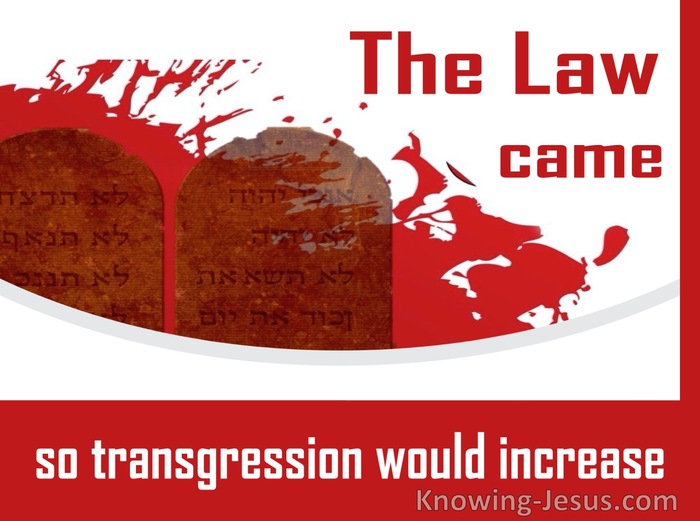
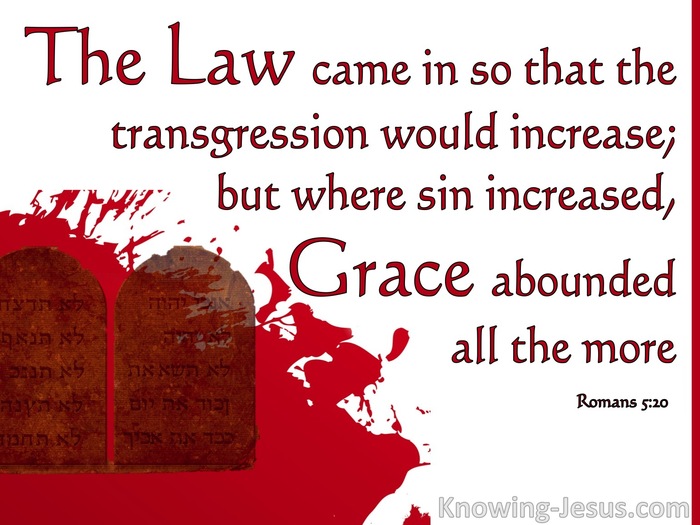
And law came in, that the offence might abound, and where the sin did abound, the grace did overabound,
New American Standard Bible
King James Version
Moreover the law entered, that the offence might abound. But where sin abounded, grace did much more abound:
Holman Bible
The law came along to multiply the trespass.
International Standard Version
Now the Law crept in so that the offense would increase. But where sin increased, grace increased even more,
A Conservative Version
And the law entered so that the offence might abound. But where sin abounded, grace was more abundant,
American Standard Version
And the law came in besides, that the trespass might abound; but where sin abounded, grace did abound more exceedingly:
Amplified
But the Law came to increase and expand [the awareness of] the trespass [by defining and unmasking sin]. But where sin increased, [God’s remarkable, gracious gift of] grace [His unmerited favor] has surpassed it and increased all the more,
An Understandable Version
Now the law of Moses was introduced [into the world] in order to cause sin to increase [i.e., it defined many things to be wrong that were previously not regarded as sin]. But with the increase of sin, God's unearned favor increased all the more.
Anderson New Testament
But, besides the first offense, law was introduced, in order that offenses might abound: but where sin abounded, grace did much more abound:
Bible in Basic English
And the law came in addition, to make wrongdoing worse; but where there was much sin, there was much more grace:
Common New Testament
Law came in, that the trespass might increase. But where sin increased, grace abounded all the more,
Daniel Mace New Testament
the law was introduc'd, that the greatness of the fall might fully appear; but the more sin display'd its enormity, the divine favour was so much the more transcendent.
Darby Translation
But law came in, in order that the offence might abound; but where sin abounded grace has overabounded,
Godbey New Testament
But the law came, that the transgression might abound; but where sin did abound, there did grace superabound:
Goodspeed New Testament
Then law slipped in, and multiplied the offense. But greatly as sin multiplied, God's mercy has far surpassed it,
John Wesley New Testament
But the law came in between, that the offence might abound: yet where sin abounded, grace did much more abound:
Julia Smith Translation
And the law entered, that the fall might abound. And where sin abounded, grace superabounded:
King James 2000
Moreover the law entered, that the offense might abound. But where sin abounded, grace did much more abound:
Lexham Expanded Bible
Now the law came in as a side issue, in order that the trespass could increase, but where sin increased, grace was present in greater abundance,
Modern King James verseion
But the Law entered so that the offense might abound. But where sin abounded, grace did much more abound,
Modern Spelling Tyndale-Coverdale
But the law, in the meantime, entered in that sin should increase. Neverthelater, where abundance of sin was, there was more plenteousness of grace.
Moffatt New Testament
Law slipped in to aggravate the trespass; sin increased, but grace surpassed it far,
Montgomery New Testament
Now law was brought in so that transgression might abound; but where sin abounded, grace super-abounded;
NET Bible
Now the law came in so that the transgression may increase, but where sin increased, grace multiplied all the more,
New Heart English Bible
The law came in besides, that the trespass might abound; but where sin abounded, grace abounded more exceedingly;
Noyes New Testament
Moreover the law came in in addition, that the trespass might abound; but where sin abounded, grace abounded much more;
Sawyer New Testament
For the law supervened that the fall might abound; but where the sin abounded the grace was superabundant,
The Emphasized Bible
Law, however, gained admission, in order that the fault might abound, but, where the sin abounded, the favour greatly superabounded:
Thomas Haweis New Testament
But the law was introduced, that the offence might be more abundant. But where sin had abounded, there hath grace abounded more exceedingly:
Twentieth Century New Testament
Law was introduced in order that offences might be multiplied. But, where sins were multiplied, the loving-kindness of God was lavished the more,
Webster
Moreover the law entered, that the offense might abound. But where sin abounded, grace did much more abound:
Weymouth New Testament
Now Law was brought in later on, so that transgression might increase. But where sin increased, grace has overflowed;
Williams New Testament
Then law crept in to multiply the offense. Though sin has multiplied, yet God's favor has surpassed it and overflowed,
World English Bible
The law came in besides, that the trespass might abound; but where sin abounded, grace abounded more exceedingly;
Worrell New Testament
And the law entered, that the trespass might abound; but where sin abounded, grace did super-abound;
Worsley New Testament
Now the law made some entrance, that the offence might appear to abound; but where sin abounded, grace hath superabounded; that as sin had reigned in death,
Themes
Adam » The first man. Creation of » Temptation and sin of
death » How death entered into the world
Grace » Described as » All-abundant
Justification before God » Under the gospel » Is of grace
Topics
Interlinear
De
De
References
Word Count of 37 Translations in Romans 5:20
Images Romans 5:20





Prayers for Romans 5:20
Verse Info
Context Readings
Death Came Through Adam But Life Comes Through Christ
19 for as through the disobedience of the one man, the many were constituted sinners: so also through the obedience of the one, shall the many be constituted righteous. 20 And law came in, that the offence might abound, and where the sin did abound, the grace did overabound, 21 that even as the sin did reign in the death, so also the grace may reign, through righteousness, to life age-during, through Jesus Christ our Lord.
Cross References
Romans 6:1
What, then, shall we say? shall we continue in the sin that the grace may abound?
2 Chronicles 33:9-13
And Manasseh maketh Judah and the inhabitants of Jerusalem to err, to do evil above the nations that Jehovah destroyed from the presence of the sons of Israel.
Psalm 25:11
For Thy name's sake, O Jehovah, Thou hast pardoned mine iniquity, for it is great.
Isaiah 1:18
Come, I pray you, and we reason, saith Jehovah, If your sins are as scarlet, as snow they shall be white, If they are red as crimson, as wool they shall be!
Isaiah 43:24-25
Thou hast not bought for Me with money sweet cane, And with the fat of thy sacrifices hast not filled Me, Only -- thou hast caused Me to serve with thy sins, Thou hast wearied Me with thine iniquities.
Jeremiah 3:8-14
And I see when (for all the causes whereby backsliding Israel committed adultery) I have sent her away, and I give the bill of her divorce unto her, that treacherous Judah her sister hath not feared, and goeth and committeth fornication -- she also.
Ezekiel 16:52
Thou also -- bear thy shame, That thou hast adjudged to thy sisters, Because of thy sins that thou hast done more abominably than they, They are more righteous than thou, And thou, also, be ashamed and bear thy shame, In thy justifying thy sisters.
Ezekiel 16:60-63
And I -- I have remembered My covenant with thee, In the days of thy youth, And I have established for thee a covenant age-during.
Ezekiel 36:25-32
And I have sprinkled over you clean water, And ye have been clean; From all your uncleannesses, and from all your idols, I do cleanse you.
Micah 7:18-19
Who is a God like Thee? taking away iniquity, And passing by the transgression of the remnant of His inheritance, He hath not retained for ever His anger, Because He -- He delighteth in kindness.
Matthew 9:13
but having gone, learn ye what is, Kindness I will, and not sacrifice, for I did not come to call righteous men, but sinners, to reformation.'
Luke 7:47
therefore I say to thee, her many sins have been forgiven, because she did love much; but to whom little is forgiven, little he doth love.'
Luke 23:39-43
And one of the evil-doers who were hanged, was speaking evil of him, saying, 'If thou be the Christ, save thyself and us.'
John 10:10
The thief doth not come, except that he may steal, and kill, and destroy; I came that they may have life, and may have it abundantly.
John 15:22
if I had not come and spoken to them, they were not having sin; but now pretext they have not for their sin.
Romans 3:19-20
And we have known that as many things as the law saith, to those in the law it doth speak, that every mouth may be stopped, and all the world may come under judgment to God;
Romans 4:15
for the law doth work wrath; for where law is not, neither is transgression.
Romans 6:14
for sin over you shall not have lordship, for ye are not under law, but under grace.
Romans 7:5-13
for when we were in the flesh, the passions of the sins, that are through the law, were working in our members, to bear fruit to the death;
1 Corinthians 6:9-11
have ye not known that the unrighteous the reign of God shall not inherit? be not led astray; neither whoremongers, nor idolaters, nor adulterers, nor effeminate, nor sodomites,
2 Corinthians 3:7-9
and if the ministration of the death, in letters, engraved in stones, came in glory, so that the sons of Israel were not able to look stedfastly to the face of Moses, because of the glory of his face -- which was being made useless,
Galatians 3:19-25
Why, then, the law? on account of the transgressions it was added, till the seed might come to which the promise hath been made, having been set in order through messengers in the hand of a mediator --
Ephesians 1:6-8
to the praise of the glory of His grace, in which He did make us accepted in the beloved,
Ephesians 2:1-5
Also you -- being dead in the trespasses and the sins,
1 Timothy 1:13-16
who before was speaking evil, and persecuting, and insulting, but I found kindness, because, being ignorant, I did it in unbelief,
Titus 3:3-7
for we were once -- also we -- thoughtless, disobedient, led astray, serving desires and pleasures manifold, in malice and envy living, odious -- hating one another;